/
March 18, 2026
/
#
Min Read
Navigating the EU Battery Passport: What OEMs Need to Know Before 2027
The EU Battery Regulation (2023/1542) sets a hard deadline: by February 18, 2027, EV batteries, industrial batteries over 2 kWh, and light means of transport batteries placed on the European market must have a digital Battery Passport. For OEMs and their suppliers, that deadline is closer than it sounds - and the data requirements behind it are more demanding than a typical compliance exercise.
What the regulation actually requires
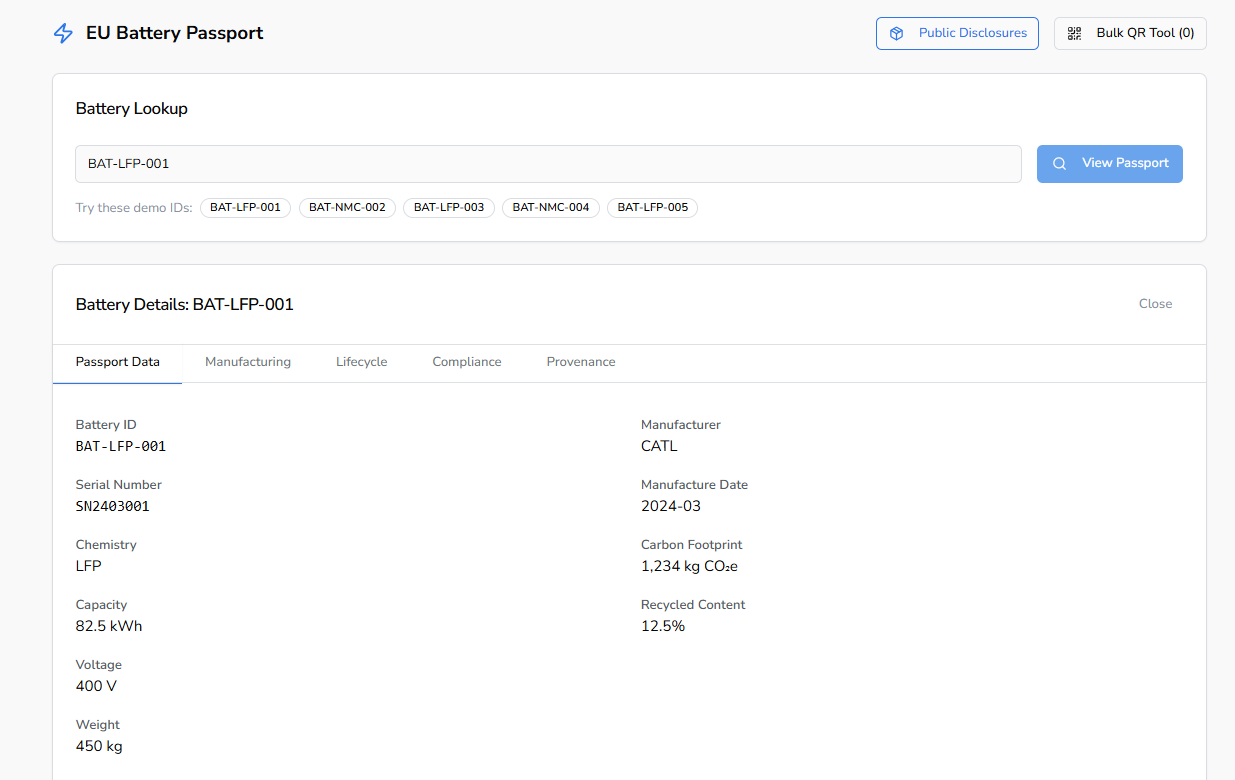
The Battery Passport isn't a single document - it's a dynamic digital record tied to each individual battery, accessible via a QR code or data carrier on the physical unit. It must capture:
- Carbon footprint across the full production lifecycle, broken down by life cycle stage and declared in kg CO₂e per kWh of capacity
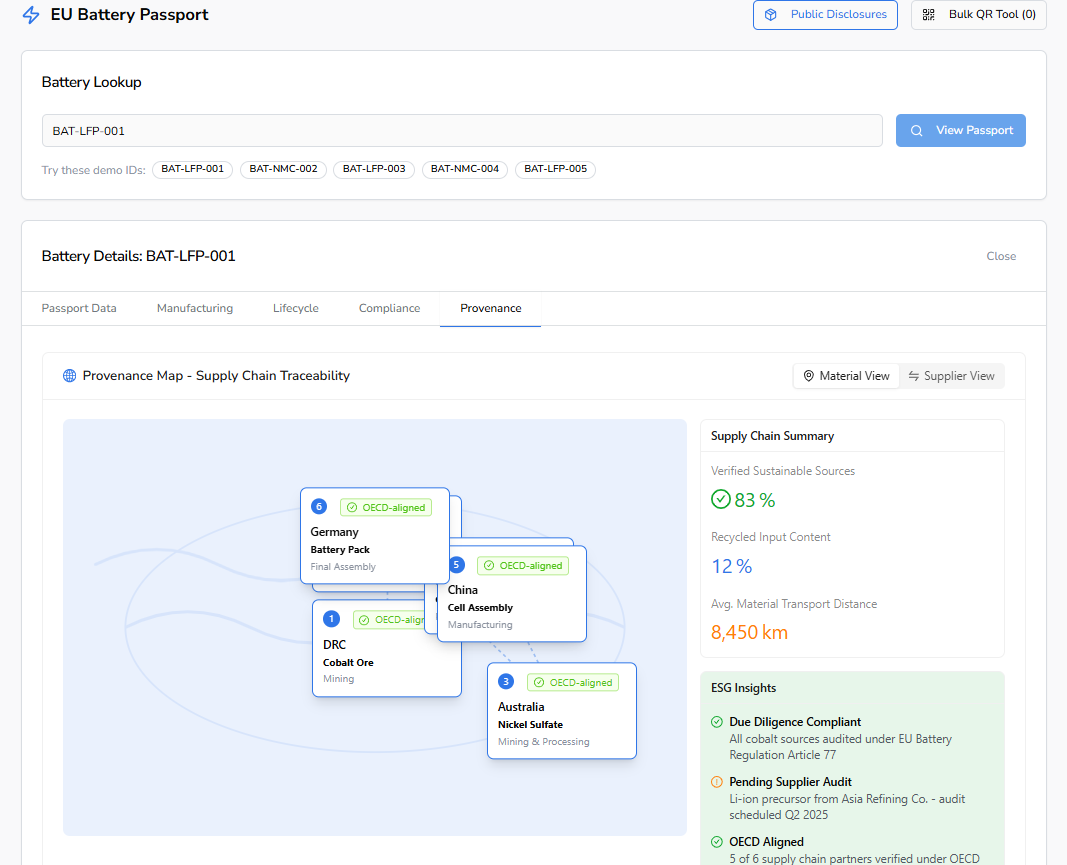
- Material composition and origin - including the sourcing of cobalt, lithium, nickel, and natural graphite, with traceability to the extraction or processing site
- Recycled content - declared percentages for recovered cobalt, lithium, lead, and nickel in active materials
- Technical performance and durability - rated capacity, expected lifetime, and operating temperature range
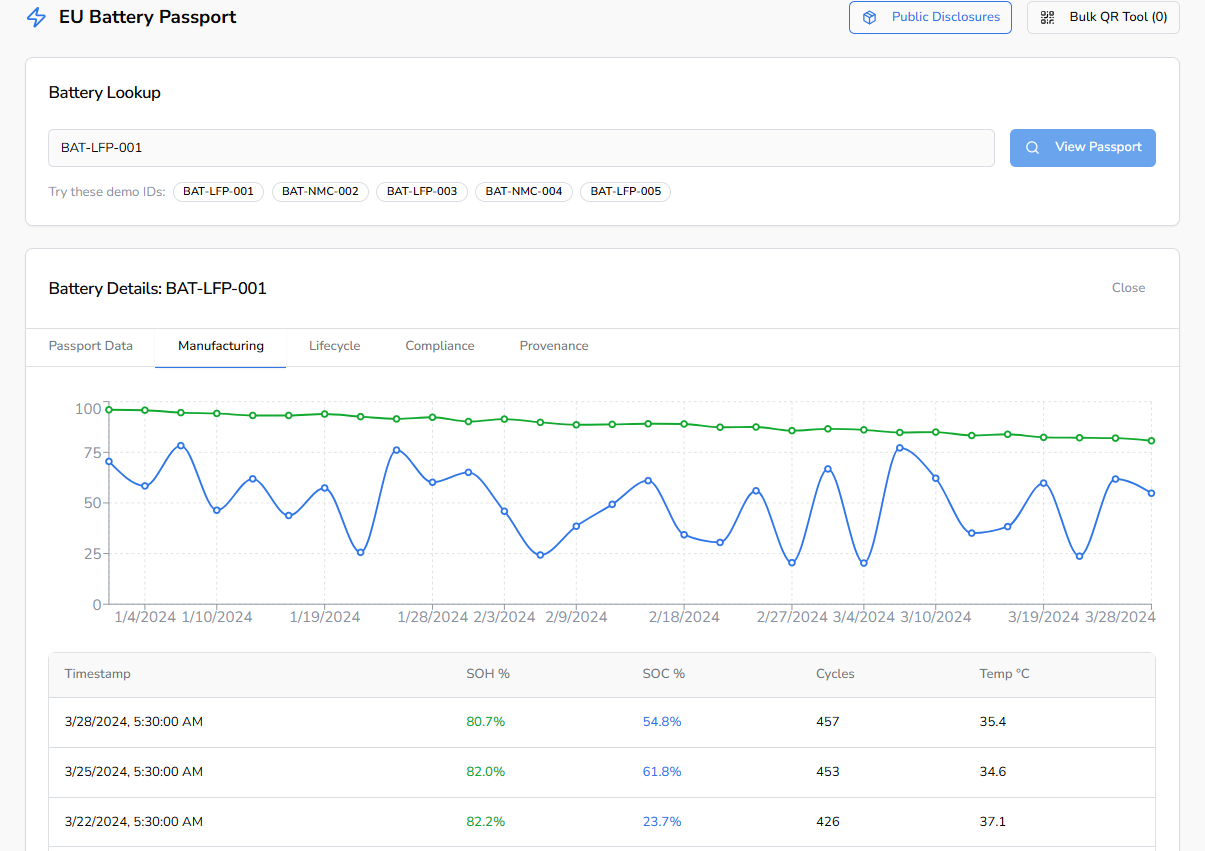
- State of health - updated over the battery's operational life, not just at point of manufacture
- Supply chain due diligence - documentation demonstrating compliance with the regulation's responsible sourcing obligations
The regulation applies across passenger cars, commercial trucks, two-wheelers, and buses. It also covers industrial batteries above 2 kWh used outside of vehicles - meaning the scope extends well beyond traditional automotive.
Phased timeline
The 2027 deadline for Battery Passports follows earlier requirements already in force. Carbon footprint declarations became mandatory in early 2025 for EV batteries, with performance classes and maximum thresholds phasing in through 2026 and 2028. Recycled content targets for 2030 and 2035 are already written into the regulation, giving manufacturers a long runway - but one that requires infrastructure built now, not later.
Non-compliance carries real consequences. Batteries without a valid passport cannot be placed on the EU market. The regulation also gives member state authorities the power to restrict or withdraw non-compliant products and impose penalties, with enforcement expected to tighten as the market adjusts.
Where most teams get stuck
The regulation's data requirements collide directly with how automotive supply chains typically operate. A finished EV battery pack involves dozens of suppliers across multiple tiers - cell manufacturers, cathode and anode material producers, module assemblers, BMS suppliers - each with their own data systems, formats, and levels of digital maturity.
In practice, this creates several compounding problems:
Fragmented data ownership. No single entity in the supply chain holds all the data the passport requires. Carbon footprint data lives with raw material and cell suppliers. Assembly data lives with the Tier 1. Performance data lives with the OEM. Getting these into a single coherent record requires structured data-sharing agreements and technical integrations that most supply chains don't have today.
Inconsistent data standards. "Carbon footprint" means different things measured at different points, under different methodologies. Without a common calculation framework, the numbers from different suppliers aren't comparable or aggregable - and the regulation requires a specific methodology (aligned with EN ISO 14067 and the EU Product Environmental Footprint framework).
Supplier readiness gaps. Many Tier 2 and Tier 3 suppliers - especially outside Europe - don't yet have systems capable of generating the traceability data the regulation requires. OEMs are ultimately responsible for the completeness of their passports, which means they carry the compliance risk for their suppliers' data gaps.
Dynamic data requirements. Unlike a one-time type approval, the Battery Passport must be updated throughout the battery's operational life. State of health data, for instance, changes continuously. This requires a live data connection - not a static submission - and infrastructure that can receive, validate, and store updates at scale across a full production fleet.
The result for most OEMs today: a fragmented mix of spreadsheets, supplier questionnaires, and manual validation processes that don't scale and can't reliably produce audit-ready data before a deadline.
What a working solution looks like
Closing this gap operationally means building a centralized system that can aggregate data across the supply chain, validate it against regulatory requirements, and maintain it dynamically over each battery's life. The core capabilities that matter in practice:
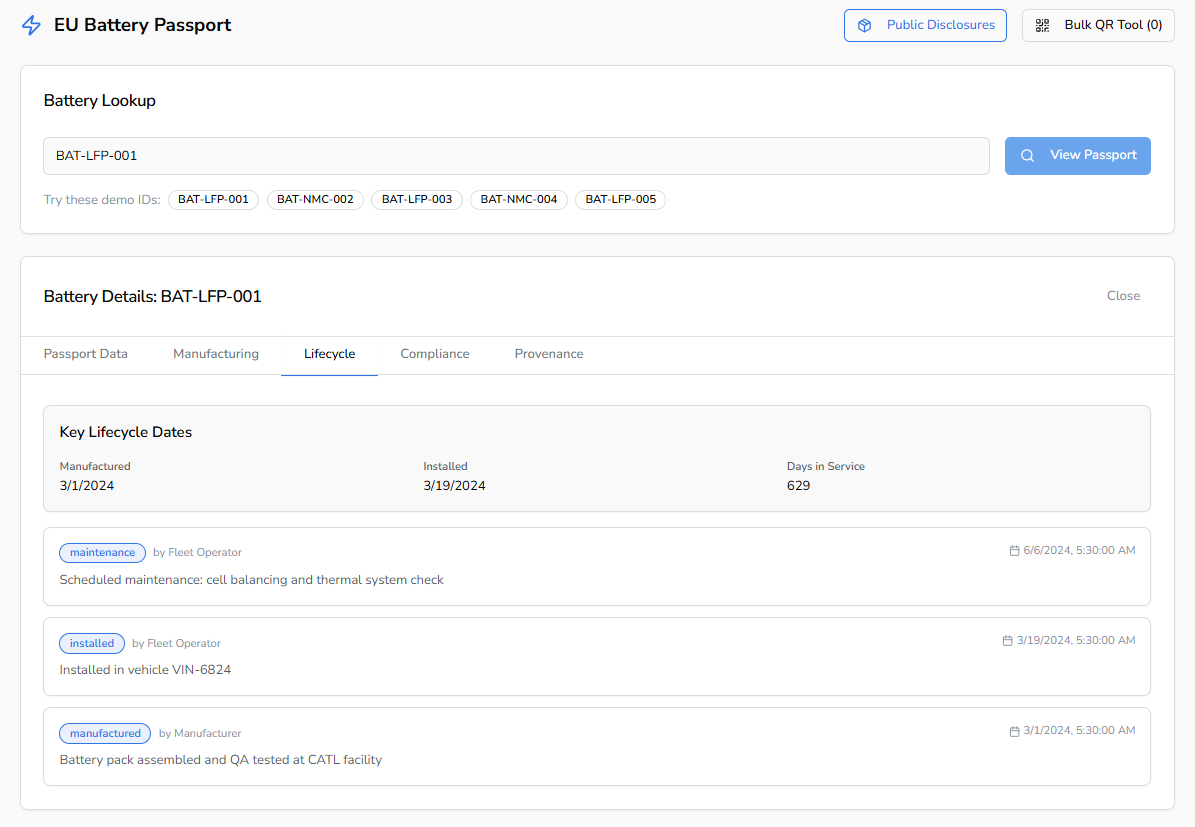
Cell-to-pack genealogy tracking. Each battery passport needs a traceable lineage from individual cells through module assembly to the finished pack. This means recording which cells went into which modules, which modules into which packs, and which packs into which vehicles - with timestamps and custody records at every step. Without this, it's impossible to reconstruct the provenance data the regulation requires if a question arises post-deployment.
Carbon footprint calculation. The regulation requires lifecycle carbon footprint declared at the battery level, broken down by production stage. This means aggregating upstream emissions data from cell and material suppliers, applying the correct calculation methodology, and producing a figure that's both accurate and verifiable. It can't be estimated or averaged across a production run - it needs to be traceable to the specific battery.
Material traceability. For critical raw materials - cobalt, lithium, nickel, natural graphite - the regulation requires documentation back to extraction or processing site. This is the hardest data to obtain, especially for batteries with complex, multi-country supply chains. A working system needs to receive this data from suppliers in a structured format and flag gaps before they become compliance issues.
Supplier data gap management. One of the most operationally useful capabilities is visibility into what's missing before it's needed. Rather than discovering a data gap during an audit or at passport submission, teams need dashboards that show which suppliers have outstanding data obligations, which fields are incomplete, and which batteries are at risk of non-compliance - far enough in advance to act on it.
Audit-ready documentation. When regulators or market access authorities request supporting evidence, the system needs to produce it quickly and completely: traceable evidence for each data field, clear chain-of-custody records, and version history showing when data was submitted and validated.