/
March 5, 2026
/
#
Min Read
Eyes on the Road: How Connected Video Streaming Is Redefining Fleet Safety and Accountability
Real-Time Camera Intelligence for the Vehicles, Fleets, and Operations That Can't Afford to Be Blind
A long-haul truck merges into a construction zone. A passenger coach picks up students near a school crossing. An autonomous shuttle navigates a dense urban corridor. In each of these moments, a camera is watching - but whether that footage is useful depends entirely on what happens next.
For most fleets today, video data is reactive. A camera records, footage sits siloed in an onboard unit, and it only gets retrieved after something goes wrong - if it gets retrieved at all. The infrastructure to stream, tag, manage, and act on that video in real time simply hasn't existed at scale in connected vehicles. Until now.
From Incident Recording to Live Operational Intelligence
The shift happening across commercial trucking, transit, school transportation, and even industrial vehicle fleets isn't just about upgrading cameras. It's about connecting video to the broader operational picture - vehicle telemetry, location, driver behavior, and compliance state - so that teams can move from passive recording to active situational awareness.
Consider a few scenarios already unfolding across industries:
Transit and public bus operators are under mounting pressure from municipalities and regulators to demonstrate passenger safety. Live camera access during active routes gives dispatch teams and security operations centers the ability to monitor incidents as they develop - not hours later when reviewing stored footage. When a disturbance is flagged, operators can respond in real time, routing support or alerting authorities before the situation escalates.
School bus fleets face unique compliance and liability dynamics. Parents, districts, and insurers all have a stake in what happens on board. Video linked directly to route, stop, and student load events provides a defensible record that protects drivers, administrators, and students alike. Consent management and privacy masking for minors isn't a nice-to-have - it's a legal requirement.
Commercial trucking and last-mile delivery fleets are navigating rising insurance premiums and increasing third-party liability claims. Real-time video overlaid with speed, braking, and GPS data gives risk and safety managers the context to validate - or refute - claims quickly. Faster resolution means lower claim costs and fewer fraudulent payouts.
Construction and industrial vehicle fleets operating on job sites rely on camera feeds not just for safety, but for project documentation, equipment utilization tracking, and subcontractor compliance. Geo-fenced video capture tied to specific work zones creates a spatial record that project managers can reference for disputes, audits, or insurance purposes.
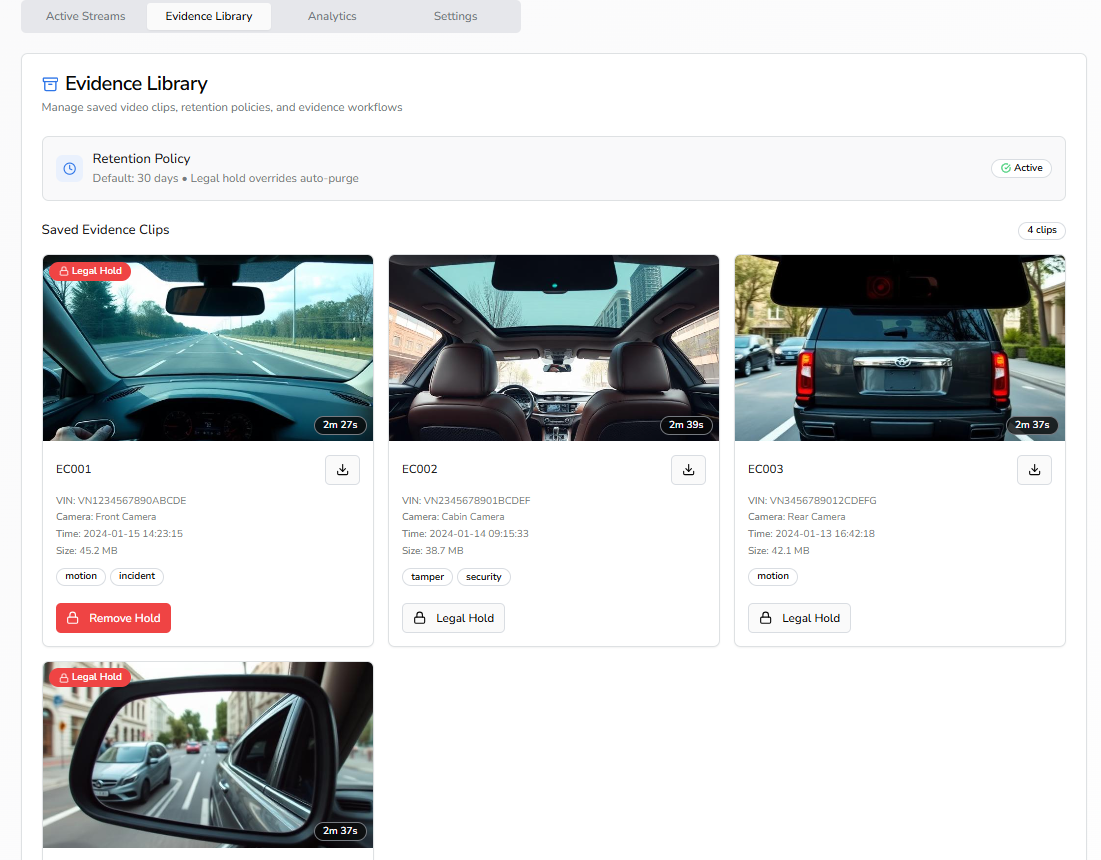
Emergency and public safety vehicles - ambulances, fire apparatus, utility trucks - represent a category where real-time visibility is both operationally critical and legally sensitive. Live streaming to command centers during active responses, paired with automatic evidence archiving, supports after-action review, training, and liability management in ways that traditional DVR-based systems cannot.
The Business Case Is Clearer Than the Road Ahead
Across each of these use cases, the business value converges on three outcomes: faster response, reduced liability exposure, and stronger compliance posture.
Faster response is straightforward. When a fleet manager can see what a driver sees in real time, the time between incident and action collapses. Whether that's dispatching support, flagging a safety concern, or pulling footage for an insurance adjuster, the operational tempo improves dramatically.
Reduced liability exposure is where the financial case is most compelling. Insurance premiums for commercial fleets have risen significantly in recent years, driven in part by large bodily injury verdicts - a trend the industry has labeled "nuclear verdicts." Fleets that can produce time-stamped, telemetry-linked video evidence quickly are in a fundamentally different negotiating position than those relying on driver testimony alone.
Compliance posture is the third pillar, and it's becoming increasingly structural. Privacy regulations including GDPR, CCPA, and emerging state-level frameworks impose real obligations on how video data is captured, retained, and accessed. Fleets that treat consent management and retention policy as afterthoughts are accumulating regulatory risk quietly. Those that build compliant video infrastructure proactively are turning a liability into a differentiator.
Why Most Fleet Video Solutions Fall Short
The challenge with deploying connected video at scale isn't the camera hardware - it's everything that surrounds it. Most existing fleet video solutions were built as standalone systems: an onboard recorder with a portal bolted on. They weren't designed to operate within a broader vehicle data architecture, integrate with telematics streams, or enforce policy across a mixed fleet of makes, models, and configurations.
The result is fragmentation. Engineering teams, safety teams, compliance teams, and claims teams are all working from different data sources, different systems, and different timelines. The footage that matters most often lives in the wrong place or gets lost in operational handoffs.
What connected video streaming requires isn't just better hardware or faster uploads. It requires a platform that understands vehicles - VINs, configurations, consent states, geofenced operating contexts - and can manage video as a first-class data type within that framework.
Sibros and the Video Streaming Hub
Sibros built the Deep Connected Platform (DCP) to manage exactly this kind of complexity at the vehicle and fleet level. The same infrastructure that handles over-the-air software updates, diagnostic data collection, and fleet telemetry serves as a foundation for connected video streaming capabilities, designed for how modern fleets actually operate.
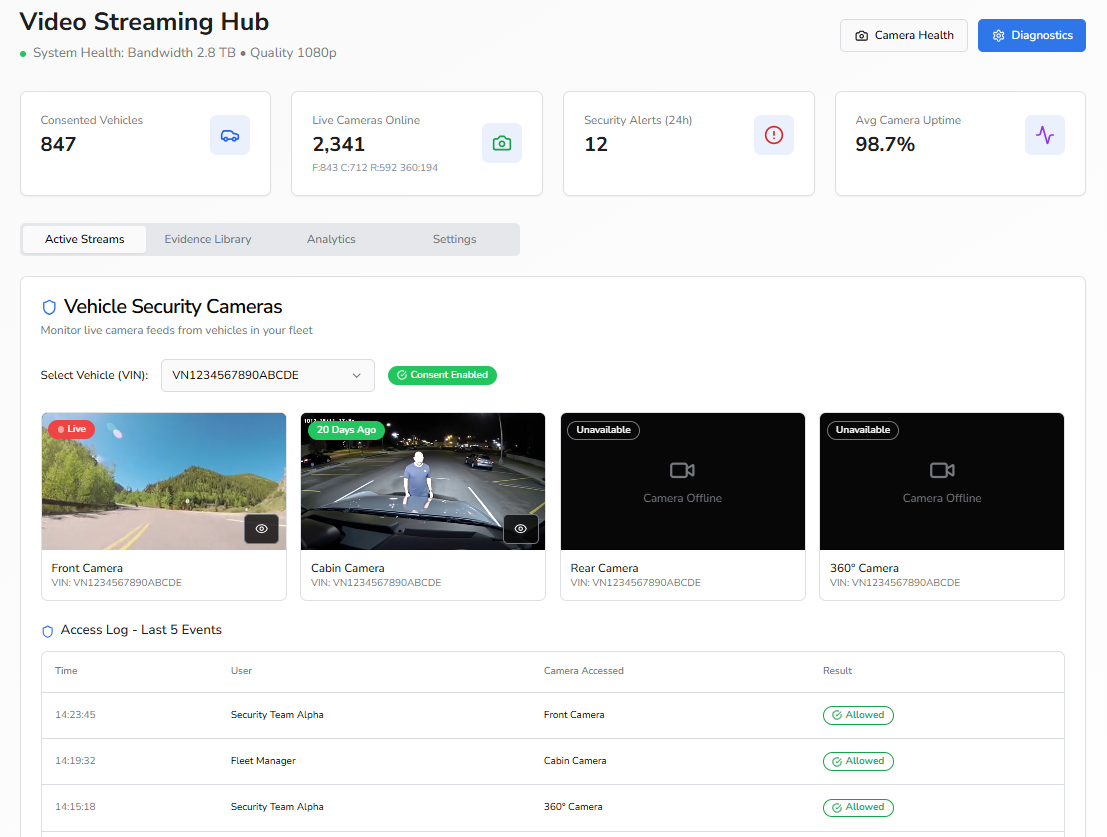
Connected video streaming powered by DCP can bring together multi-camera live streaming, VIN-linked access and consent tracking, geo-fencing restrictions, face and license plate masking, and an evidence library - all managed through the same platform operators already use for vehicle lifecycle management.
For OEMs, fleet operators, and mobility service providers exploring what responsible, scalable video streaming looks like in a software-defined vehicle context, the Video Streaming Hub represents a direction worth watching.
Learn more about the possibility of Video Streaming on the Sibros Marketplace.


Related posts

Latest Posts

Monitor live vehicle cameras with consent control, privacy masking, and legal-compliant evidence storage for fleet and security operations.