.jpeg)
/
April 17, 2026
/
#
Min Read
Your Diagnostics Tool Shouldn’t Need a Translator
How the SOVD Client Gives OEMs a Single Interface for Bay, Proximity, and Remote Diagnostics
Picture a technician at a dealership workshop. She’s diagnosing intermittent torque reduction on a vehicle with a zonal architecture, two high-performance computers, fourteen UDS ECUs, and three containerized apps on the ADAS domain controller. The DTC points to the vehicle control unit, but the root cause might span the motor controller, the BMS thermal logic, and a recent OTA calibration update that touched all three domains.
To work this, she needs a proximity tester connected via DoIP for the UDS ECUs, a remote dashboard for OTA campaign history, and a laptop running an engineering client to query the HPC’s diagnostic services. Three tools, three interfaces, three mental models. Multiply that across every technician, market, and variant, and the inefficiency compounds fast.
This is the problem Service-Oriented Vehicle Diagnostics was designed to solve - and the reason Sibros built an end-to-end SOVD solution. Not just a spec-compliant API layer, but a complete stack from the embedded gateway to the cloud, with the SOVD Client as the unified interface that ties it all together.
Diagnostic Fragmentation Is Getting Worse
The industry has spent decades standardizing diagnostics - ISO 22900 for the modular VCI, UDS for ECU communication, ODX for diagnostic specifications. These were meaningful steps. But the vehicle architecture kept moving. Zonal layouts introduced high-performance computers that UDS was never designed to handle. HPCs expose diagnostic capabilities at runtime through services and APIs, not through pre-authored ODX specifications loaded onto an offline tester. Meanwhile, OTA-capable vehicles pushed diagnostics beyond the workshop into remote troubleshooting and proactive service workflows.
The result: OEMs maintain separate toolchains for proximity, remote, and in-vehicle diagnostics - each with its own interface, data model, and maintenance burden. Every ECU variant change or firmware update potentially requires reconfiguration across all three. For a global OEM supporting dozens of vehicle platforms, the compounding cost is measured in tens of millions annually in tool development and maintenance alone.
What SOVD Changes
SOVD (ASAM / ISO 17978) flips the architecture. Instead of the diagnostic tool carrying detailed knowledge of every ECU’s internal structure, the vehicle becomes the service provider. The tool becomes a lightweight client that discovers available services at runtime via RESTful APIs over HTTP with JSON payloads. No specialized VCI hardware for HPC diagnostics, no ODX parsing stack, no proprietary protocol translators.
SOVD introduces function-level diagnostics that span multiple ECUs and domains. A single request can address “powertrain health” or “ADAS sensor status” rather than querying ECUs one at a time. And it natively supports all three diagnostic modes - proximity, remote, and onboard - through the same standardized API. One protocol, one data model, regardless of how the tool connects to the vehicle.
Critically, SOVD doesn’t replace UDS. It complements it. For traditional ECUs, the SOVD gateway translates requests into UDS commands using ODX specifications, so OEMs can adopt incrementally - new HPCs expose native SOVD services while legacy ECUs are bridged transparently.
Why End-to-End Matters
SOVD is a standard - it defines interfaces, not implementations. Sibros delivers SOVD as a fully integrated capability within the Deep Connected Platform, the same platform already handling OTA updates, remote commands, data logging, and fleet analytics for production vehicles.
On the vehicle, Sibros firmware runs the SOVD gateway on the TCU - handling session management, entity discovery, fault data access, and update orchestration within the existing firmware footprint. In the cloud, the Sibros backend exposes SOVD APIs alongside its existing APIs, with entity maps and capability descriptions managed as part of the vehicle model (supporting ODX, PDX, and OpenAPI-compliant imports). At the application layer, the SOVD Client brings it all together.
Inside the SOVD Client
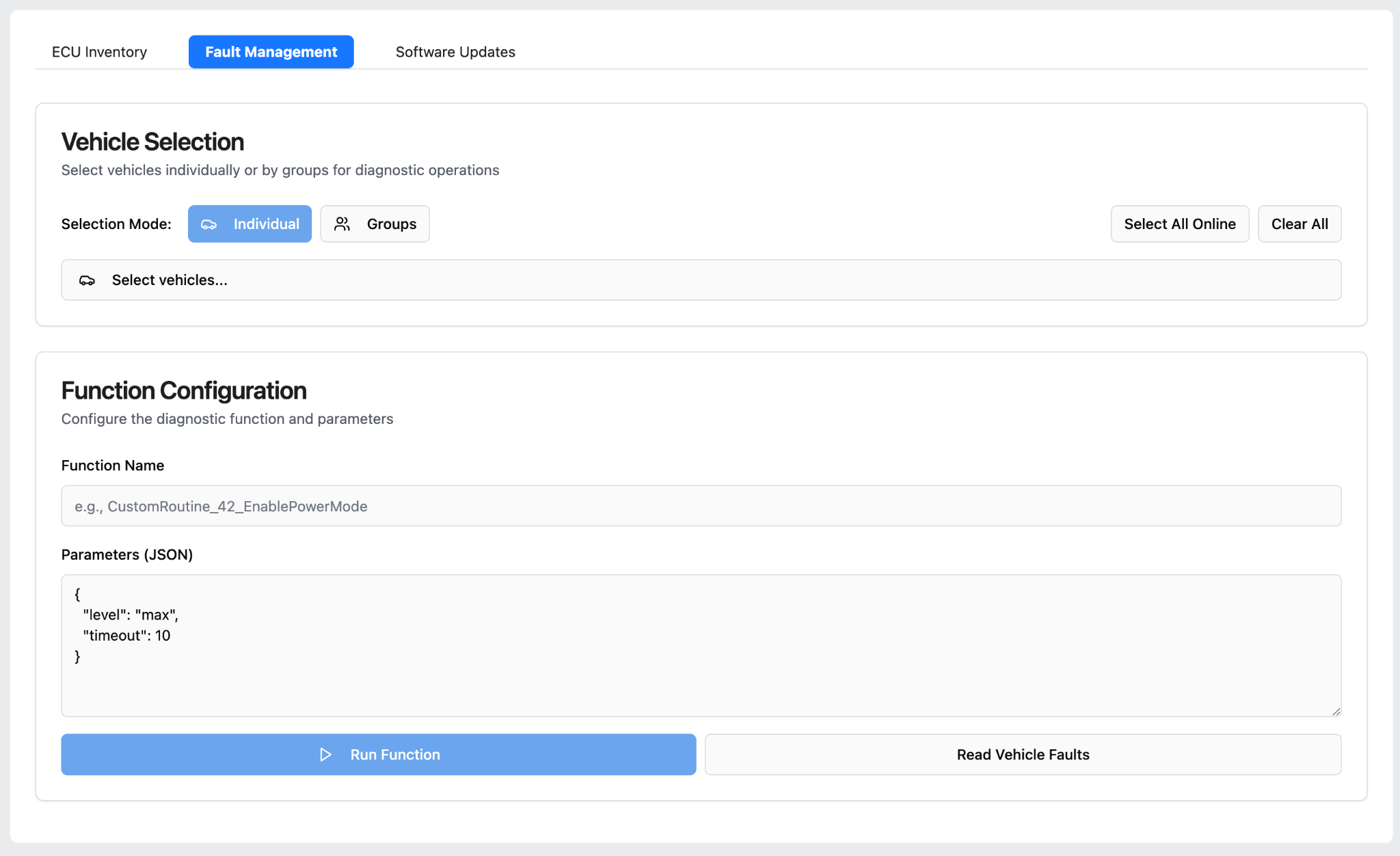
The SOVD Client is the interface service teams interact with daily. A centralized dashboard shows connectivity status, API health, session locks, and active diagnostic workflows in one place - eliminating the context switching that kills efficiency when technicians bounce between tools for different vehicle systems.
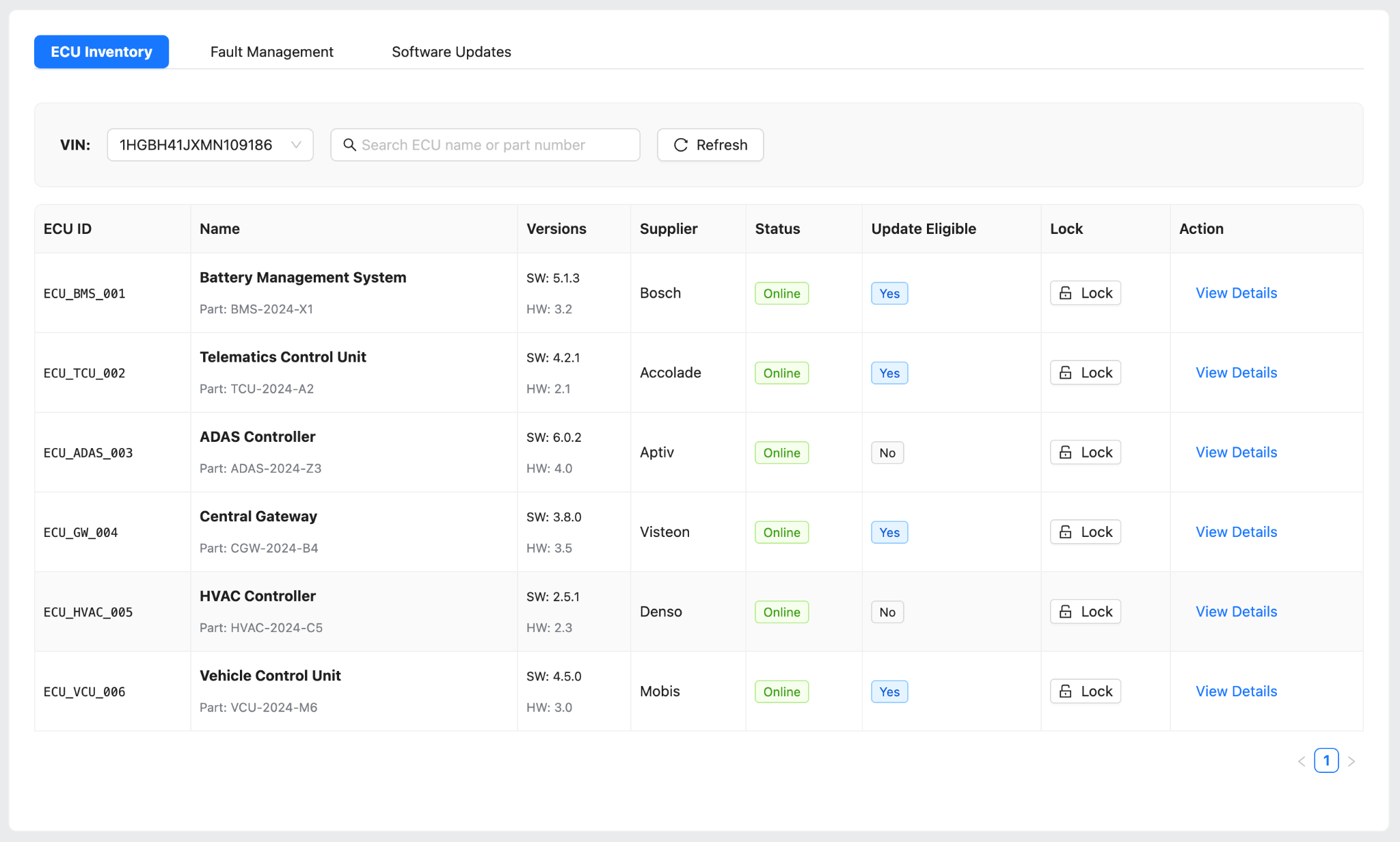
ECU inventory gives a complete picture of every controller in the vehicle - including HPCs and hosted applications - with software version details, entity relationships, and configuration state. For OEMs managing complex variant matrices, this visibility alone can meaningfully reduce the “no fault found” part swaps that remain stubbornly expensive across the industry.
Fault management provides structured resolution workflows with the richer context SOVD enables: health states, bulk data captures, environment snapshots, and pre-defined KPIs. And OTA campaign visibility connects diagnostics directly to the software update lifecycle - when a fault correlates with a recent deployment, the technician sees exactly what changed without switching consoles.
Production Line to Workshop
In manufacturing, SOVD’s dynamic service discovery simplifies end-of-line testing. Instead of maintaining variant-specific tester configurations, the EoL system discovers what services the vehicle exposes at runtime. Parallel ECU access over IP reduces takt time. And because procedures adapt automatically after post-SOP software changes, the line doesn’t need reconfiguration every time a feature ships via OTA.
In aftersales, the impact is direct. Remote diagnostics via the SOVD Client let engineering teams triage before the vehicle reaches the workshop. The same standardized tooling serves global operations instead of regional forks. The result: faster first-time-fix rates, fewer unnecessary part swaps, and lower warranty costs across the board.
Getting Started
The SOVD Client is available on the Sibros Marketplace as part of Sibros’ broader SOVD solution. For OEMs evaluating SOVD adoption, Sibros also offers professional services for custom client development, proximity and onboard implementations, and advisory services for SDV planning and architecture reviews.
Explore the SOVD Client on the Sibros Marketplace, or learn more about Sibros’ end-to-end SOVD solution at Sibros.tech.


Latest Posts

Standards-based SOVD client for OEMs to streamline diagnostics, fault management, and OTA software updates across bay, proximity, and remote workflows.

Sibros 的 R156 就绪跟踪器可自动收集证据和监控欧洲货币单位就绪情况,以简化欧洲经委会 R156 下的监管合规性。